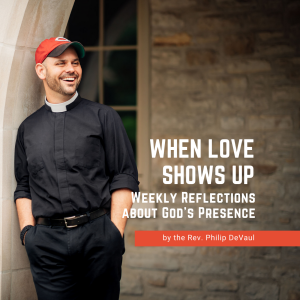
When Love Shows Up: Weekly Reflections about God’s Presence
Welcome to When Love Shows Up: Weekly Reflections about God’s Presence by the Rev. Philip DeVaul, Rector at the Episcopal Church of the Redeemer in Cincinnati, Ohio.
Listen on:

Episodes
Jan 30, 2026
Jan 30, 2026
13 min
The temptation to locate God within my own party and preference is universal – and it is ongoing. I will always struggle with the desire to align God with me rather than the other way around. I am reminded of Ann Lamott saying, "You can safely assume you've created God in your own image when it turns out that God hates all the same people you do."
Seeking the middle ground has a lot going for it. There is something really healthy about saying let’s find a place to meet. Let’s find a place where our common values outweigh our differences, let’s find our connections wherever we can. Let’s share a meal and a prayer and look out for each other even though we disagree about things. Like the song goes, Clowns to the left of me jokers to the right, here I am stuck in the middle with you. That’s the idea anyway.
The other day I was listening to an interview with American documentarian Ken Burns while driving across town, and I almost had to pull over. In the midst of what seemed like a very casual conversation, he said these words: “There’s only us. There’s no Them. And if anyone tells you there’s a Them, run away. There’s only Us.”
There’s only Us.
What else is there to say?
Want to support our podcast? Give Here
Jan 23, 2026
Jan 23, 2026
16 min
My favorite band of all time is The Beatles. Nobody whose favorite band is the Beatles could claim in good conscience to be an extremist. The most popular pop band of all time? Forget it. I’m a moderate. I just am. Let’s be real about my temperament, about my preferences: I like moderation. I like institutions. I like the sense of stability and belonging. I wear a uniform to work! I remember when I took the confirmation class at an Episcopal Church when I was 23. They made an explicit point of telling us over and over that we didn’t have to join – we could just be there, we didn’t have to be Episcopalian. But I like brands and organizations and belonging and I wanted to be called an Episcopalian – a denomination historically known for staid, moderate behavior. The old joke goes how many Episcopalians does it take to change a lightbulb? “What’s change?”
What even is moderation? What is centrism? Is it the idea that there are two extremes and the truth lies somewhere in the middle – in some kind of muddled compromise where nobody is perfectly happy and nobody is perfectly furious? I mean, I love that. I really do. It fits my temperament so well, and frankly it’s convenient to my lifestyle. It is also very often a pragmatic approach to life. And so many of us across the political spectrum have noted the unfortunate move towards extremism in our government – often bolstered by gerrymandering and corporate interference for profit. We would love a representative body that finds some kind of imperfect middle ground.
Want to support our podcast? Give Here
Jan 16, 2026
Jan 16, 2026
13 min
If I want to approach the world through a Christian lens then, before I asked what is conservative or liberal, what is Republican or Democrat, what is libertarian or socialist, what is Red or Blue, what is MAGA or Antifa, I would begin by saying what does it look like to try to create a community, a culture, a country that seeks and serves Christ in every person, that strives for justice and peace, that respects the dignity of every human being? That seems like a fairly good guideline for a Christian approach to morality and humanity.
So, politics aside, do I believe in heavily armed masked men detaining people in the streets based on their looks, the color of their skin, their accents? Do I believe in families being separated and kept in cages in my country? Do I believe in imprisonment and deportation without due process? Do these things seem moral to me? Do they seem humane?
Want to support our podcast? Give Here
Jan 8, 2026
Jan 8, 2026
12 min
Over the years my faith has ebbed and flowed, my desire to be close to God has sometimes been strong, and other times I have doubted the very existence of the God I worship and have dedicated my life to serve. And I am often frustrated or even horrified by Christianity as I see it being expressed around me – as a tool of judgment, ostracization, oppression, and violence.
At the age of 13, raised and immersed in church culture, I had read Paul’s words many times before. When this time it found me I was spiritually adrift and obsessed with the idea that I needed to figure it all out – that I needed to prove God’s existence and then reach that proven God on my own power, to find Jesus, to know exactly what I believed and to live it just right. And then I heard Paul say that before I had ever even thought about reaching out to God, God had already reached out and taken hold of me. And all I can tell you is in that moment I believed it.
And, God help me, I still believe it.
Want to support our podcast? Give Here
Dec 19, 2025
Dec 19, 2025
12 min
What are the little things that make it Christmas for you? What has shaped your perceptions of Christmas – of what it’s supposed to be? Likely, it’s a combination of your personal experiences and the ways the holiday has been presented to you by your culture growing up – what was on tv or the radio, what commercials or movies you remember, what foods your grandmother made.
For me it’s watching National Lampoon’s Christmas Vacation and A Christmas Story. My dad on the roof putting up the lights, getting a real Christmas tree, singing carols, the little plastic Santa that sat on our front porch all lit up from within, getting dark early, the smell of cigarettes and taste of lemon bars and fudge at my grandma’s house where we had our annual Christmas Eve party. A well decorated shopping mall with way too many people. These things make it feel like Christmas to me.
I love the movie Christmas Vacation. I watch it every year. This year our middle child was finally old enough to watch it: A rite of passage in our family. Actually, to say I love Christmas Vacation is sort of irrelevant. Love is beside the point: It’s a part of how I experience Christmas. I saw it in the theater in December of 1989 with my family. I was 10 years old. I have seen it at least once nearly every year since then. It’s not Christmas until the lights on the Griswold’s house blind the neighbors. This movie has shaped my very perception of what Christmas is supposed to be. How could it not?
Dec 12, 2025
Dec 12, 2025
13 min
About ten years ago I was working with this therapist and it was a very good fit. She and I had both grown up in similar religious, geographical, and cultural contexts, and we both had come to similar places in our relationships with those things. Which is to say I felt heard and understood, and she was able to speak a language to me that didn’t need a lot of translation. I learned a lot from her about life and about myself. But the thing she taught me that may stick with me the most – at least on a conscious level – was something about God.
I was speaking with her about the pursuit of perfection: My desire to get everything right, to be the right kind of person, and specifically my belief that I needed to make all the right choices in order to be that right kind of person. I wanted to get it right, you know. And I wanted to get it right for God. It seemed like the least I could do. But I put a lot of pressure on myself to do that: To get it right for God, to make the right choices for God. To be the person God thought I could be. I was not able to see what a burden I was placing on myself in all this. But my therapist saw it.
Want to support our podcast? Give Here
Dec 5, 2025
Dec 5, 2025
14 min
So there I was last Sunday putting up Christmas lights. It was the first week of Advent. I had spent the morning preaching at church. Now I was in my front yard. I was on a ladder. I had my Christmas mega playlist of over 500 of my favorite holiday themed songs set to shuffle on a speaker on the porch. I had the Santa hat on. And I was miserable. I could barely hear the music over how much I was cussing to myself. It was cold. My hands were numb if I wore no gloves, but when I put the gloves on I could not manage the lights. My family had given up and were inside drinking hot chocolate. I didn’t even want to hear the songs that were coming on. Merry Christmas indeed.
Expectations will kill you. Every time.
Want to support our podcast? Give Here
Nov 21, 2025
Nov 21, 2025
15 min
We do not and cannot hear the Bible in a vacuum. We are living in a time when our country is radically reducing support for those who are poor and struggling. We are seeing this most drastically with the federal attack on SNAP funding – our primary food assistance program for those in need. The threads of the social safety net are actively being cut. More and more people are finding themselves on the margins of society, and once there, they are finding less help than ever before. Some careless, clueless Christian leaders will even use the text from 2 Thessalonians to support this action.
Much of the rhetoric around reduction and removal of this kind of assistance is that it incentivizes people not to work – that essentially people are lazy and these programs reward their laziness. Anyone unwilling to work should not eat. This is an age-old and pernicious characterization that allows us to distance ourselves from those in need, allows us to conveniently sidestep our mutual belonging, our responsibility to one another.
It also ignores reality.
Want to support our podcast? Give Here
Nov 14, 2025
Nov 14, 2025
14 min
Regardless of how Jesus responds, it is essential for us to recognize and name this: The question itself is disingenuous. It is not asked with sincerity. It is not asked with respect. It is not asked out of curiosity. It is not asked with the desire to engage for the sake of a deeper understanding of how Jesus’ mind works. The challengers seek only to trap Jesus, to shut him down, to disprove him. He is not a sibling, friend, or conversation partner: He is a threat. They posture themselves as wanting to sit at Jesus’ feet and learn, but the narrator lets us know ahead of time that this is pure pretense. They are acting in bad faith.
We are well acquainted in our own time with disingenuity in disagreement. We are quite capable of recognizing bad faith questions disguised as debate.
Argument and debate are important parts of relationships and of living in a society. But not all argument is created equal. There is a marked difference between trying to reach an understanding and trying to win. In one, the goal is to know one another better and find a place of connection – even in disagreement. In the other, the goal is to be right and prove the other wrong. That’s it.
Want to support our podcast? Give Here
Nov 7, 2025
Nov 7, 2025
13 min
In any case, it’s certainly not a straight answer, as centuries of varied interpretations attest.
This anecdote is often seen as Jesus refusing to engage in politics. He declines to clearly answer an explicitly political question, and his riddle of an answer has the whiff of separating church from state. This text then is often used by Christians as a way of discouraging the mix of religion and politics. It is especially used by Christians when another Chrisitan is espousing a political perspective that makes us uncomfortable.
Please understand that the question posed to Jesus is not asked genuinely – and I will say/write more about that next week. But it is worth saying here that the question is not asked with a desire for understanding Jesus’ perspective: It is a trap. Whichever way Jesus answers is problematic. Not because it is political, but because it is partisan. For Jesus to answer in either direction would put him in a category with a specific existing political constituency. To radically oversimplify things for our current context, the ones asking the question are doing something akin to getting Jesus to tell them if he is a Republican or a Democrat. Those who confront Jesus aren’t seeking his wisdom, aren’t interested in learning from him: They want to know which group to put him in so that he can be more easily classified, managed, and dismissed.
Want to support our podcast? Give Here