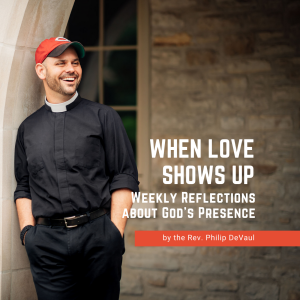
When Love Shows Up: Weekly Reflections about God’s Presence
Welcome to When Love Shows Up: Weekly Reflections about God’s Presence by the Rev. Philip DeVaul, Rector at the Episcopal Church of the Redeemer in Cincinnati, Ohio.
Listen on:

Episodes
Oct 16, 2026
Oct 16, 2026
9 min
Rev. Phil announces that at the end of next week they will join a group, mostly from Church of the Redeemer, on a pilgrimage to the U.S.-Mexico border to be united with immigrant siblings, grow spiritually, and witness God’s truth in the lives of people who cross the border. Phil shares a prayer asking for deeper connection with God and companions, attentive listening to stories, and love for others as they are. The prayer seeks God’s presence, growth through discomfort, and expanded understanding of healing and reconciliation, while confessing complacency amid intentional, cruel, racist terrorizing of immigrants. He asks to be inspired by the Holy Spirit and sent back to act justly, love magnificently, serve humbly, and be “converted” by God’s presence in others.
Oct 8, 2026
Oct 8, 2026
12 min
Rev. Phil describes hospital chaplaincy training at Washington Hospital Center, a level one trauma center, where on-call overnight shifts included responding to “code yellow” trauma arrivals. During the first code yellow, Rev. Phil realized he had no clear role while medical staff, a police officer, and a social worker acted, so he silently prayed and learned the charge nurse considered that his contribution. Hoping to be useful, he took many shifts and occasionally prayed with patients or families, including accompanying a family to view a young man who died from a gunshot wound, an experience that made “usefulness” feel irrelevant. Over time, Rev. Phil concluded his still presence—watching, praying, and bearing witness—mattered and changed how he entered difficult spaces. He connects this to a belief that God lovingly bears witness, and he anticipates doing the same on an upcoming church pilgrimage to the border.
Sep 25, 2026
Sep 25, 2026
9 min
Rev. Phil recalls reading Geoffrey Chaucer’s The Canterbury Tales in high school without grasping that its characters were Christian pilgrims to Canterbury, later appreciating how their shared stories built community. Citing Professor Ellen Davis, Rev. Phil notes pilgrimage is not part of our dominant American cultural experience and contrasts true pilgrimage—aimed at transformation—with nostalgic “pilgrimages” like visiting In-N-Out or Skyline Chili. Rev. Phil reminds us that Church of the Redeemer is currently on a real pilgrimage into a new chapter, including a forthcoming trip to the borderlands as a manifestation of the wider journey toward a beloved community that knows Jesus and grows in love. Even if not everyone recognizes the pilgrimage, the church is clearly building Christ-centered community through shared life, ministry, worship, prayer, and mutual care, embracing transformation despite imperfection.
Want to support our podcast? Give Here
Sep 18, 2026
Sep 18, 2026
13 min
Rev. Phil describes the congregation’s seven-year commitment to the Episcopal Church initiative Becoming Beloved Community, focused on racial justice, healing, and reconciliation in a predominantly white tradition. They stress the work is spiritual and social, personal and political, ongoing rather than a program, and organized around four pillars: telling the truth about the church and race, proclaiming the dream of beloved community, practicing the way of love, and repairing the breach in society and institutions. Grounding the call in Jesus and Paul’s teaching that Christ breaks down hostility, the speaker argues the U.S. remains shaped by white supremacy and that pursuing justice is like swimming against a tide or running up a down escalator. They connect this to a planned pilgrimage to the borderlands intended to decenter themselves, learn from migrant neighbors, and be transformed.
Sep 11, 2026
Sep 11, 2026
10 min
Rev. Phil argues that Job can be understood as a pilgrim, not through physical travel but through a holy, transformative spiritual journey into grief, sorrow, and suffering that feels arbitrary and undeserved. Though Job stays put, he is taken into a foreign inner “land,” and in a sense the pilgrimage passes through him. Early in the story, three friends join him, first weeping and sitting in silence for seven days, showing that his misery belongs to them too; later their nonstop attempts to explain his suffering are misguided but still signify love and solidarity. The narrator connects this to personal pilgrimage on Italy’s Cinque Terre, emphasizing that pilgrims are never truly alone. Ultimately, God appears as Job’s “destination,” offers no explanation, and embodies being both revealed and mysterious, leaving Job transformed and not alone.
Want to support our podcast? Give Here
Sep 3, 2026
Sep 3, 2026
12 min
The idea that my Christianity would be at odds with my patriotism makes me wildly uncomfortable. I hate it, really. For as long as I can remember I’ve been a Christian, and for as long as I can remember I’ve been American. I remember watching a US aircraft carrier docking in San Diego. I was in 6th grade, and that ship was carrying a family friend who had been deployed in the Persian Gulf. As the ship pulled in, its deck lined with uniformed sailors, the loudspeakers blared “I’m Proud to be an American” and I felt it in my 11-year-old bones. And God bless America, I thought. This country that has formed me has been in my prayers since I could pray.
I love Jesus and I love America, and I am not interested in changing either of those things any time soon. I have to admit, though, that I have been conditioned to believe that my love of country and my obedience to Jesus are synonymous – or at least that they are cozy bedfellows, resting comfortably with each other side by side, never at odds with one another. And this is profoundly problematic.
America is not Christian, and it never was. Even if the majority of people who created this country identified as Christian, it was not a Christian country at its founding. And it wasn’t founded with Judeo-Christian values, because there is no such thing as Judeo-Christianity. That phrase is a modern invention with no teeth and less meaning. And as a lifelong (and professional) Christian, I am fine with America not being Christian. I just want us to be honest about it.
This episode originally aired 07/04/25
Aug 28, 2026
Aug 28, 2026
14 min
Rev. Phil reflects on immigration enforcement after American sailor Joshua Aviles, deployed over nine months on the record-setting USS Lincoln, learns that his father Luis Manuel Aviles was arrested by ICE during a racially targeted traffic stop in Florida despite having a job, Social Security card, paying taxes, and pursuing a green card. Phil notes that in July ICE arrested nearly 50,000 people (about 1,600 daily), arguing many are nonviolent immigrants targeted for skin color and accents, with families separated and children detained and given court dates without parents or counsel. Connecting this to Christianity, he cites Jesus’ teaching about welcoming strangers and caring for the least, argues Christians should be angry at injustice, and warns against confusing personal prejudice with God’s anger. He describes a planned church pilgrimage to the US–Mexico border as a step toward transformation, insisting righteous anger must lead to action.
Want to support our podcast? Give Here
Aug 21, 2026
Aug 21, 2026
12 min
Rev. Phil describes preparing to join their church on a fall pilgrimage to the US–Mexico border and reflects on conflicting feelings. They list three reasons they don’t want to go: pilgrimages are uncomfortable (they’re attached to a king-sized bed and travel comforts), require physical movement (they resist being pushed to move), and are meant to transform a person (they like who they are and dislike a shame-based self-improvement narrative). They then offer three reasons they do want to go: the discomfort reveals their worship of comfort and convenience and forces emotional engagement with anger over US treatment of immigrants and refugees; movement counters confusing stagnation with stability and connects them to “immigrant siblings” defined by movement; and transformation deepens understanding of God, self, and love, embracing uncertainty and trusting God’s more imaginative plans
Aug 14, 2026
Aug 14, 2026
12 min
Rev. Phil argues that scripture repeatedly highlights the vulnerability of the immigrant experience and urges listeners to digest it, relate to it, and see themselves in it. He says many people already feel vulnerable due to economic instability, environmental volatility, and a vicious political climate, yet society is being convinced to fear immigrants as threats, which he calls a convenient lie. He emphasizes Jesus’ command to love neighbor—including those of different nationalities, cultures, religions, and races—and to seek the humanity in one another because every person bears God’s image. He presents Jesus as embodying divine vulnerability—born into poverty, becoming a refugee, living itinerantly, and suffering torture and public execution—and condemns exploiting immigrants through detention, incarceration, violence, and deportation. He frames the church’s trip to the border as a pilgrimage to connect to immigrants as family and be spiritually transformed.
Want to support our podcast? Give Here
Aug 6, 2026
Aug 6, 2026
12 min
This week’s podcast reflects on how Paul’s relationship to citizenship was complex: Jewish in identity, born in Tarsus in Roman-controlled Cilicia, raised partly in Jerusalem, and able to claim Roman citizenship to demand due process, yet ultimately executed under Nero’s campaign of terror against Christians after the great fire in Rome. It parallels Paul’s death with the killings of Lorenzo Salgado Araujo, a Mexican-born man who lived in the U.S. for 35 years while pursuing legal status, and Johan Sebastian Duran Guerrero, a documented Colombian immigrant; both were chased by agents in unmarked cars and executed after being mistaken for someone else. It defines “martyr” from Greek martureo (“to witness”) and asks whether these deaths should be recognized as martyrdoms. Rev. Phil argues that Paul’s theology rejects national, cultural, and racial barriers—“Our citizenship is in heaven”—and urges examining citizenship’s role as Church of the Redeemer approaches a borderland pilgrimage.
Want to support our podcast? Give Here